What if a lifetime of memory could be read, mapped, and continued?
MemClone is developing the theoretical and hardware architecture for whole-brain engram extraction — the foundational science behind digitizing, preserving, and one day continuing human memory and personality beyond biology.
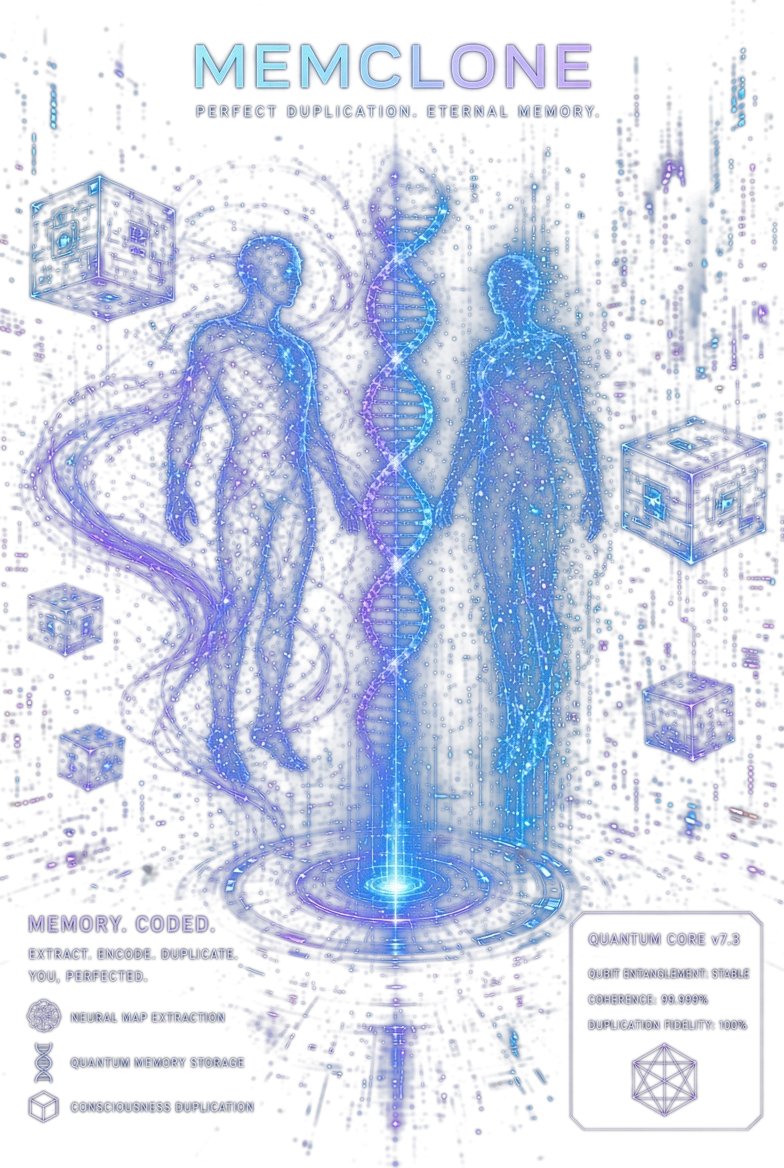
Every human memory — a face, a language, the feel of a childhood home — exists as a physical pattern of synaptic connections. Reading that pattern, at scale, with enough fidelity to reconstruct it outside the body, is one of the hardest open problems in neuroscience and computing.
MemClone is a research-stage company working on the full stack this problem requires: high-density cortical and subcortical recording hardware, on-chip neuromorphic signal processing, and cloud infrastructure to store and eventually reanimate the resulting engram data through large language models — voice, personality, memory, and likeness reconstructed as a continuous digital presence.
We publish our architecture openly because we believe memory-cloning research needs to be developed in the open, with consent and safety as first-class constraints rather than an afterthought. Read our approach →
Six problems standing between a living brain and a durable digital memory.
Cortical Engram Mapping
High-density, ultra-thin polymer electrode arrays across the prefrontal, temporal, and parietal cortices — ≥100,000 channels aimed at capturing declarative and episodic memory traces.
Hippocampal & Brain-Stem Bridging
A deep-brain interface targeting CA1/CA3 hippocampal subfields and brain-stem nuclei — indexing long-term memory consolidation and the emotional valence attached to it.
Neuromorphic Edge Processing
On-implant ASICs perform real-time spike sorting via memristor crossbar arrays, compressing raw voltage traces into structured tensors before they ever leave the skull.
Exogenous Cloud Synchronization
A continuous, low-latency telemetry pipeline that mirrors synaptic-weight blueprints to external infrastructure — a living backup of the structural graph beneath a memory.
Digital Personality Reconstruction
Engram data, combined with a person's writing, voice, photos, and video, trains a personal language model that speaks, reasons, and responds in their own likeness.
Longevity & Digital Continuity
The long-term vision: a simulated cognitive presence that persists, learns, and is recognizably continuous with the person it was built from — governed entirely by their own consent.
This is early-stage, unproven research — and we say so on purpose.
Reading dense neural activity at scale is an active, unsolved engineering problem. Writing a memory back into a brain — reproducing it with the precision needed to be recognized as "that memory" — is, as far as public science shows, not achievable today without unacceptable risk of tissue damage or seizure. We publish our architecture as a research roadmap and invite scrutiny, not as a product claim. See the full technical writeup →
Building the architecture for memory?
We're looking to collaborate with neuroscientists, BCI hardware teams, and long-term-safety researchers who want to help get this right.